
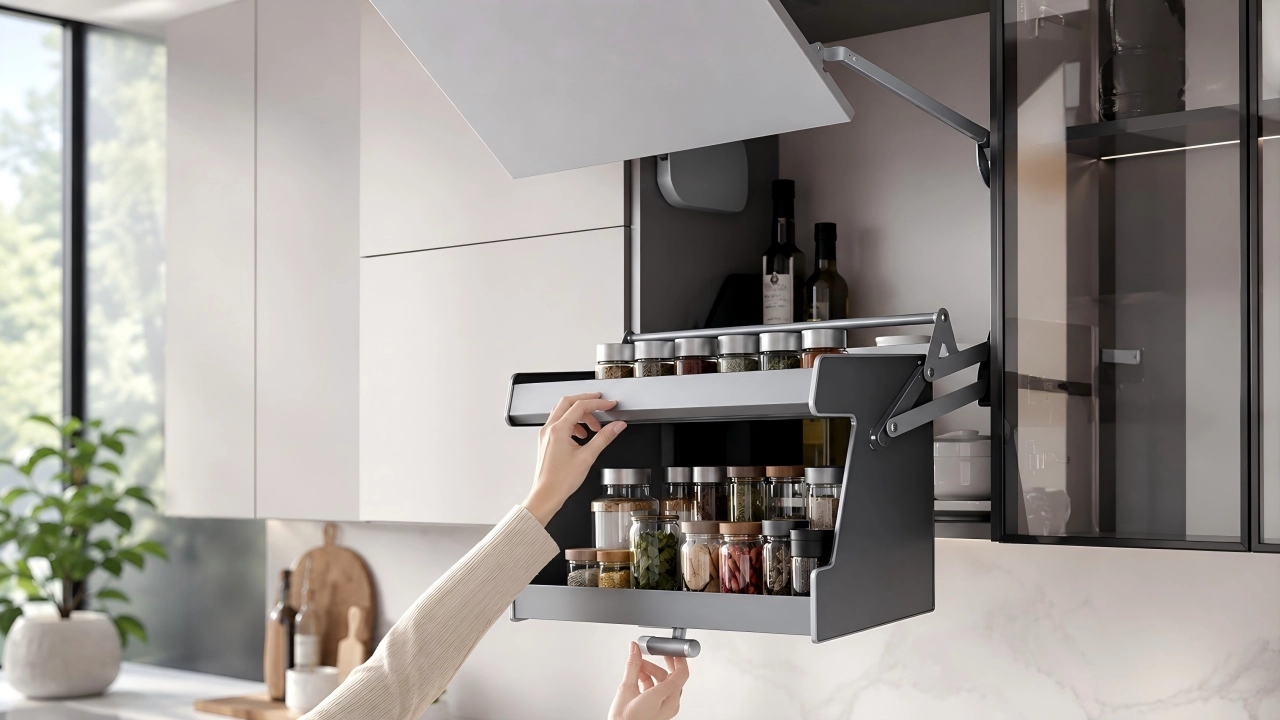
How Pull-Down Shelves Make Upper Cabinets Easier to Reach in Accessible Kitchens
At Vitafurni, we look at accessible kitchen storage from a very practical starting point: can the user reach the cabinet, lower the shelf safely, take the item with one hand if needed, and return the shelf without strain? A beautiful upper cabinet does not help much if the stored plates, spices, cups, or dry goods remain too high, too deep, or too difficult to bring down.
A pull down shelf for accessible kitchens is designed to move high storage into a lower reach zone. For cabinet brands, furniture manufacturers, distributors, and project buyers, the real selection work is not only choosing a product model. It is checking seated access, elderly use, shoulder movement, cabinet clearance, countertop obstruction, storage load, operating force, and whether the system can be installed into a new or existing kitchen cabinet.
Reach After Lowering
The shelf must stop at a height where the user can see, grip, and return items comfortably.
Operating Effort
Manual racks must be easy to pull; electric systems must lower smoothly and predictably.
Clear Movement Path
Cabinet doors, hinges, handles, faucets, appliances, and countertop items must not block descent.
Cabinet Fit
Inner width, depth, height, side fixing strength, and door opening clearance decide whether the system works.
1. How Pull-Down Shelves Make High Cabinets Easier to Use
Upper cabinets often look efficient on a kitchen drawing because they use vertical space well. In daily use, however, many high shelves become storage for rarely used items. The user may need to stand on tiptoe, stretch the shoulder, move front-row objects, or use a step stool. These actions are inconvenient for most users and can become difficult for wheelchair users, elderly users, shorter users, and people with limited shoulder or arm movement.
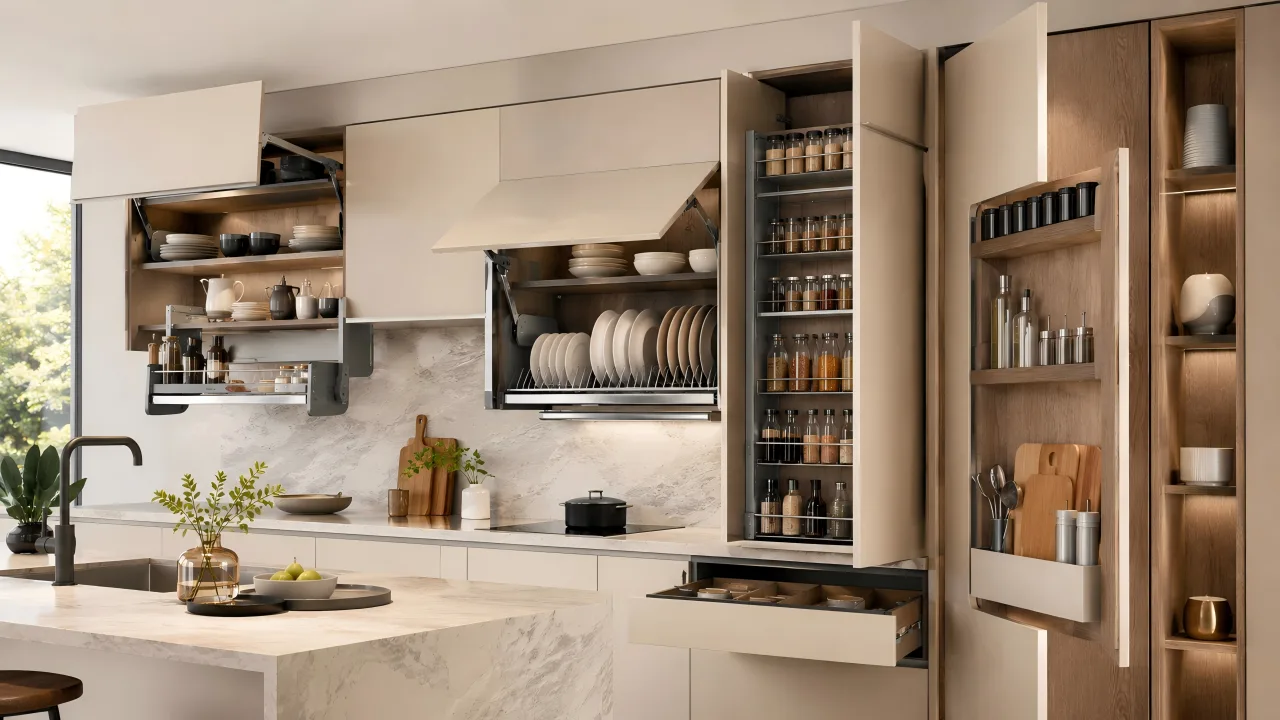
A pull-down shelf changes the access method. Instead of asking the user to reach deep into the cabinet, the basket or shelf moves forward and downward. The user can see more of the stored items, take what they need at a lower level, and return the shelf to the upper cabinet after use. This is the core value behind accessible upper cabinet storage, easy reach kitchen cabinet shelves, pull down shelves for elderly users, and seated access kitchen storage.
For cabinet manufacturers, the product value is clear only when it solves a real use problem. The shelf should not simply move. It should stop where the user can reach it, remain stable when loaded, avoid nearby obstructions, and return smoothly into the cabinet. This is why we recommend evaluating the whole access sequence: open the door, lower the shelf, see the stored items, grip the item, remove it safely, replace it, and return the shelf.
Vitafurni Planning Note: A pull-down shelf should be judged by the final lowered position, not only by the product photo. If the lowered shelf still sits too high or too far forward, the user may continue to struggle with daily access.
2. What Seated Users Need to Check
For wheelchair users or seated users, the most important factor is the reachable position after the shelf comes down. The user may not be able to lean far forward, raise the arm above shoulder level, or apply strong pulling force. A pull-down shelf should therefore lower into a zone where the user can see the contents, reach the front and middle storage areas, and return the shelf without needing to stand.
The first checkpoint is the horizontal distance from the seated position to the lowered shelf. If the user must roll too close to the base cabinet, the knees, footrest, or wheelchair frame may hit the cabinet front. If the shelf lowers over a countertop that is too deep, the user may not reach the back row of items. For accessible kitchen planning, the countertop depth, base cabinet projection, handle position, and final shelf stop point should be reviewed together.
The second checkpoint is the handle or control position. A manual system should have a handle that the user can grip before pulling. The handle should not be hidden too high inside the cabinet. An electric lift system may be easier for seated users if the control interface is placed within reach, but the project still needs to confirm power supply, wiring route, movement clearance, and safe operation space.
| Seated Access Check | What to Confirm | Why It Matters |
|---|---|---|
| Lowered Shelf Height | Check the final position after the basket or shelf descends. | The user must be able to see and grip stored items without standing. |
| Forward Reach | Review countertop depth, base cabinet projection, and distance from seating position. | A low shelf is still difficult to use if it stops too far forward or too far back. |
| Handle or Control Reach | Confirm whether the user can reach the handle, button, or touch control before operation. | The product fails the access goal if the user cannot start the movement independently. |
| Knee and Footrest Space | Check whether wheelchair positioning conflicts with base cabinet or countertop layout. | Seated access depends on the whole kitchen layout, not only the upper cabinet. |
3. What Elderly Users Need to Check
For elderly users, upper cabinet access is often affected by balance, grip strength, shoulder comfort, and confidence in the movement of the hardware. A step stool may create risk. Reaching above the head may feel unstable. Pulling a heavily loaded basket may feel too difficult if the mechanism is not matched to the storage load.
A pull-down shelf for elderly users should feel controlled. The basket should not drop suddenly, rebound sharply, or require a strong two-handed pull. A manual free-stop or damping mechanism can work well when the user can reach the handle and the load is moderate. For premium accessible kitchens, a motorized wall cabinet lift can reduce effort, but the control interface should be simple, visible, and easy to understand.
The storage plan also matters. Heavy plates, glass jars, oil bottles, and stacked bowls should not be placed into a system without checking movement stability. If elderly users will use the shelf every day, we recommend testing the sample with real household items rather than empty baskets. The user should feel the pull force, watch the lowering speed, and confirm whether the product feels safe.
Grip Comfort
The handle should be easy to hold, not too narrow, and not positioned too high inside the cabinet.
Controlled Motion
The shelf should lower and return smoothly without sudden drop, shake, or strong rebound.
Moderate Load
Store daily items that can be handled safely, and avoid overloading the basket with heavy goods.
Simple Controls
For electric systems, the control should be intuitive and placed where the user can reach it easily.
4. What Users with Shoulder or Arm Limitations Need to Check
Some users can stand and move around the kitchen, but they may have limited shoulder range, weak grip, reduced arm strength, or pain when reaching upward. For these users, the problem is not only cabinet height. The key issue is the first action: can they start the shelf movement comfortably?
A manual pull-down system should be tested for starting force. If the user must raise the arm too high to grip the handle, the product may not solve the problem. If the first pull requires too much force, the user may avoid using the shelf. If the basket becomes much harder to operate when loaded, the project should reconsider the stored item type or choose a motorized solution.
Electric systems can help reduce arm effort, but they still require access to a button, switch, touch panel, or voice function. The system should also move predictably so the user does not need to hold or guide the basket throughout the travel path. In an accessible kitchen, the best mechanism is the one that reduces both reach height and physical effort.
On-Site Test: Ask the target user to open the cabinet, start the movement, take an item, replace it, and return the shelf. This simple test shows more than a specification sheet because it reveals reach, grip, force, and confidence.
5. Cabinet Dimensions Decide Whether the System Can Be Installed
A pull-down shelf cannot be selected by product appearance alone. The cabinet must have enough clear internal space and enough structural support. For both new cabinet production and retrofit pull-down shelves for existing cabinets, buyers should confirm inner width, inner depth, inner height, side fixing condition, back panel position, hinge location, and door opening angle.
The internal width controls whether the rack frame can fit between the side panels. The internal depth controls whether the basket can return completely into the cabinet. The internal height controls whether stored items have enough vertical space and whether the mechanism can move without interference. If the cabinet has a face frame, decorative trim, thick hinges, internal lighting, or a shallow back panel, the usable space may be smaller than expected.
| Cabinet Check | How to Review | Risk if Ignored |
|---|---|---|
| Clear Inner Width | Measure the usable space between side panels after hinges and internal accessories are considered. | The rack may not fit, or side arms may rub against cabinet hardware. |
| Clear Inner Depth | Measure from the inside front opening to the back panel or rear obstruction. | The shelf may not return fully, leaving the cabinet door unable to close. |
| Clear Inner Height | Measure from the cabinet bottom panel to the top panel or fixed shelf above. | Tall items may collide, or the movement path may be restricted. |
| Side Fixing Strength | Check panel material, thickness, screw position, and whether reinforcement is needed. | The mechanism may feel unstable after repeated use. |
| Door Opening Clearance | Open the cabinet door fully and check hinge swing, door edge, handle, and face frame obstruction. | The basket may hit the door or fail to descend cleanly. |
6. Countertop Clearance and Movement Path Are Just as Important
A pull-down shelf moves outside the cabinet when it is used. That means the surrounding kitchen environment must be checked, not only the cabinet box. A shelf can be technically installed but still become inconvenient if it lowers into a coffee machine, faucet, blender, knife block, open appliance door, range hood edge, or tall oil bottle on the countertop.
For accessible kitchen projects, the movement path should remain clear during normal daily use. A user should not need to remove countertop objects before lowering the shelf. The shelf should not swing into the cooking zone or block a hot pan. It should not descend where the user’s face, arm, or wheelchair position creates a safety concern. These checks are especially important in compact apartment kitchens, assisted living kitchens, and retrofit projects where the layout is already fixed.
Countertop Appliances
Check coffee machines, kettles, mixers, blenders, air fryers, and toasters before confirming lowered position.
Sink and Faucet
If the shelf lowers above a sink area, faucet height and splashing zones must be reviewed.
Cooktop Zone
Avoid placing the lowered shelf where heat, steam, cookware, or range hood structure interferes.
Door and Hinge Path
The door must open far enough for the shelf frame and side arms to move without collision.
7. Storage Load and Operating Force Must Be Verified Together
Accessible upper cabinet storage should be tested with the actual items users plan to store. Empty baskets feel easy. Light product samples may also feel fine. The real test starts when the basket holds plates, bowls, cups, spice jars, sauce bottles, food containers, or dry goods. Load changes movement quality, starting force, stopping stability, and user confidence.
For a manual pull-down shelf, the key question is whether the user can start the movement without strain. The rack should not require a sudden hard pull. It should feel balanced as it lowers and stable as it returns. If the user must use two hands every time, the system may still be useful, but it may not be appropriate for every accessible kitchen scenario.
For an electric wall cabinet lift, the key question is whether the motorized movement matches the storage load and use frequency. We avoid making one universal promise for all models because each product should be reviewed by its own specification. Buyers should provide the intended storage items, expected load range, cabinet drawings, and target user scenario so the product can be matched correctly.
Practical Load Test Sequence
- Load the shelf with real items instead of empty display props.
- Ask the target user to operate the shelf from their normal position.
- Check whether the first pull or control action is easy enough.
- Observe shaking, tilting, rebound, or sudden movement.
- Confirm whether the user can remove and return items without moving countertop objects.
- Repeat the test several times to judge comfort, not only one successful operation.
8. New Cabinets vs Existing Kitchen Retrofit
A new cabinet project gives the buyer more control. The cabinet can be designed around the selected pull-down shelf. The internal width, height, side panel structure, door opening angle, electrical path, and control position can all be planned before production. This is the best route for cabinet brands and OEM projects that want a consistent accessible upper cabinet storage solution across multiple kitchen collections.
Retrofit projects are different. The cabinet already exists, and the installer must work within fixed dimensions. The side panels may not be strong enough. The internal height may be limited by a fixed shelf. Hinges may reduce the opening. Wiring may be difficult for electric systems. A retrofit project can still work, but the buyer needs site photos, cabinet measurements, and obstruction checks before selecting the product.
| Project Type | Better Fit | What to Confirm |
|---|---|---|
| New accessible kitchen cabinet line | Manual or electric system, selected during cabinet design. | Cabinet dimensions, target user, storage item type, control method, packaging, installation template. |
| Premium smart kitchen project | Electric wall cabinet lift or motorized lift basket. | Power supply, wiring route, control position, movement path, stored item load. |
| Existing cabinet retrofit | Manual pull-down basket when wiring or cabinet modification is limited. | Clear internal size, side panel strength, hinge clearance, countertop obstruction, handle reach. |
| Senior-friendly apartment upgrade | Manual with smooth damping or electric if control and wiring conditions are ready. | Operating effort, lowered shelf height, load behavior, simple use, maintenance access. |
9. Product Matching by Use Scenario
Rather than listing every product as a separate catalog item, we prefer matching the product to the user scenario. A seated user may need motorized operation or a very easy-to-reach handle. An elderly user may need smooth damping and moderate load. A tall upper cabinet may need a larger lowering range. A retrofit project may need a simpler mechanical structure that avoids wiring. This use-based selection is easier for buyers, installers, and sales teams to explain.
| Use Scenario | Main Access Issue | Product Direction | Buyer Checkpoint |
|---|---|---|---|
| Seated access kitchen storage | The user needs the shelf to descend into a reachable position with minimal effort. | Electric lift or carefully selected easy-reach manual system. | Lowered height, control reach, countertop depth, wheelchair approach space. |
| Pull down shelves for elderly users | The system must reduce stretching and feel stable during movement. | Manual free-stop basket with smooth damping or electric wall cabinet lift. | Handle comfort, operating force, load stability, repeated-use confidence. |
| High cabinet storage | Upper shelves are underused because items are too high or too deep. | Two-tier pull-down basket or motorized wall cabinet lift basket. | Inner cabinet height, shelf spacing, stored item height, descent clearance. |
| Existing cabinet retrofit | The cabinet is already built, and wiring or structural changes may be limited. | Mechanical pull-down system when cabinet structure allows installation. | Clear internal dimensions, side panel strength, hinge clearance, drilling tolerance. |
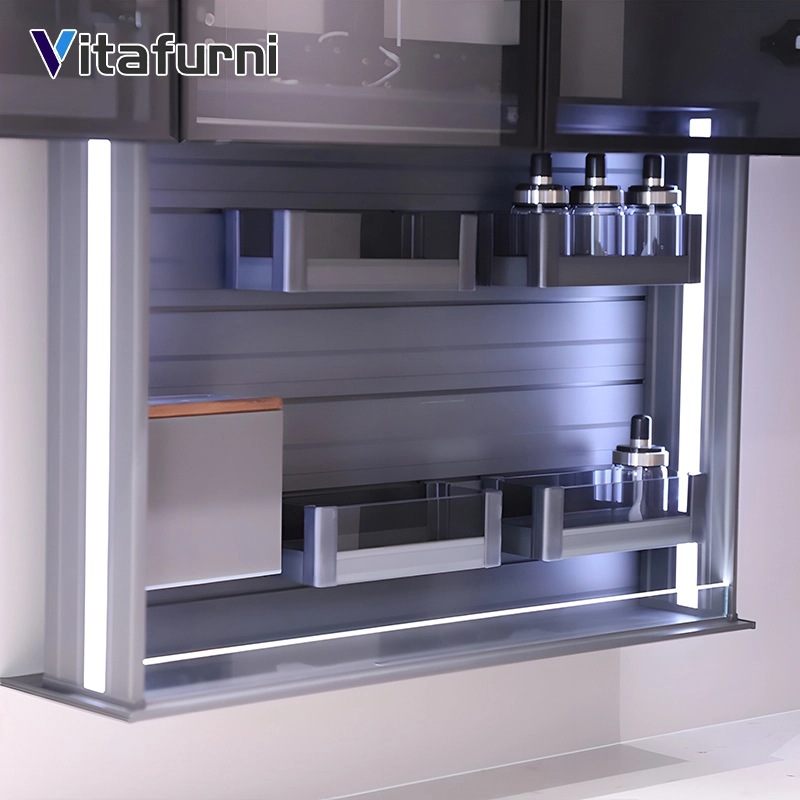
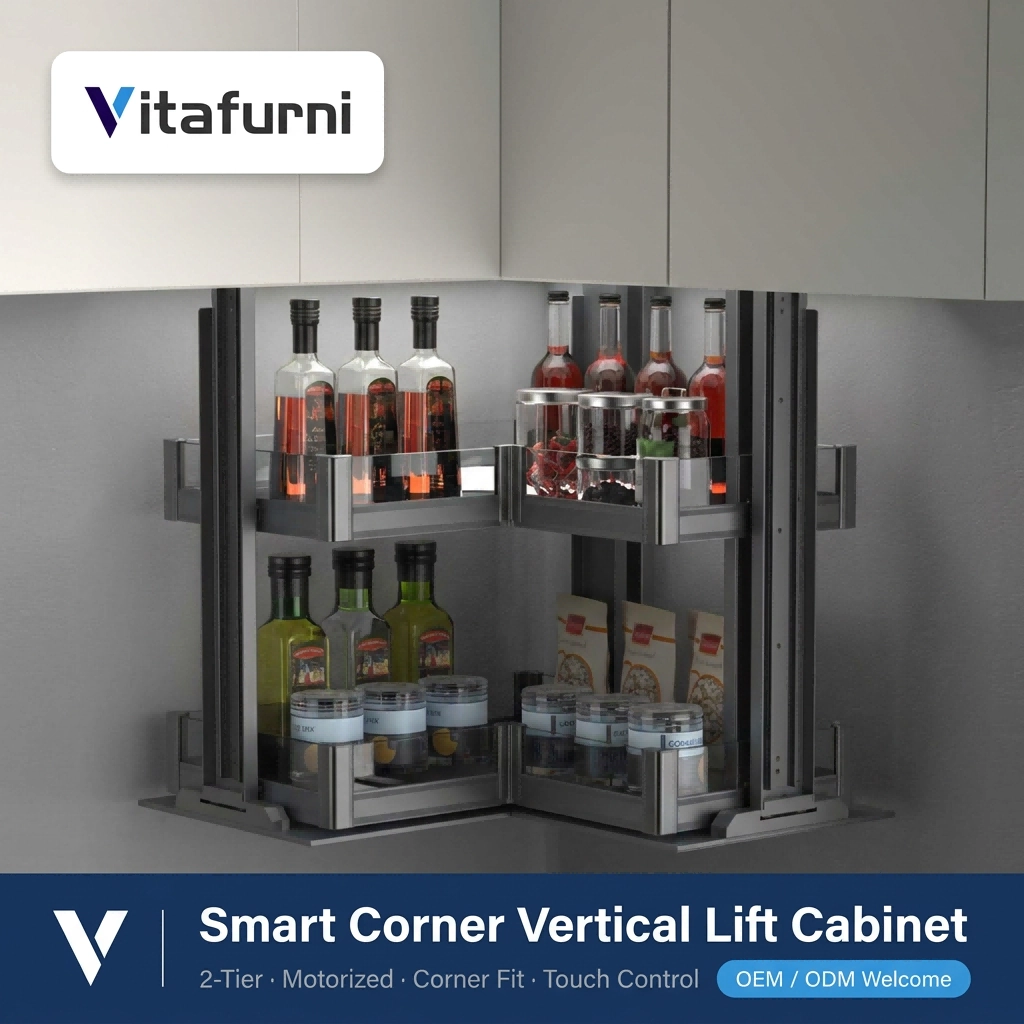
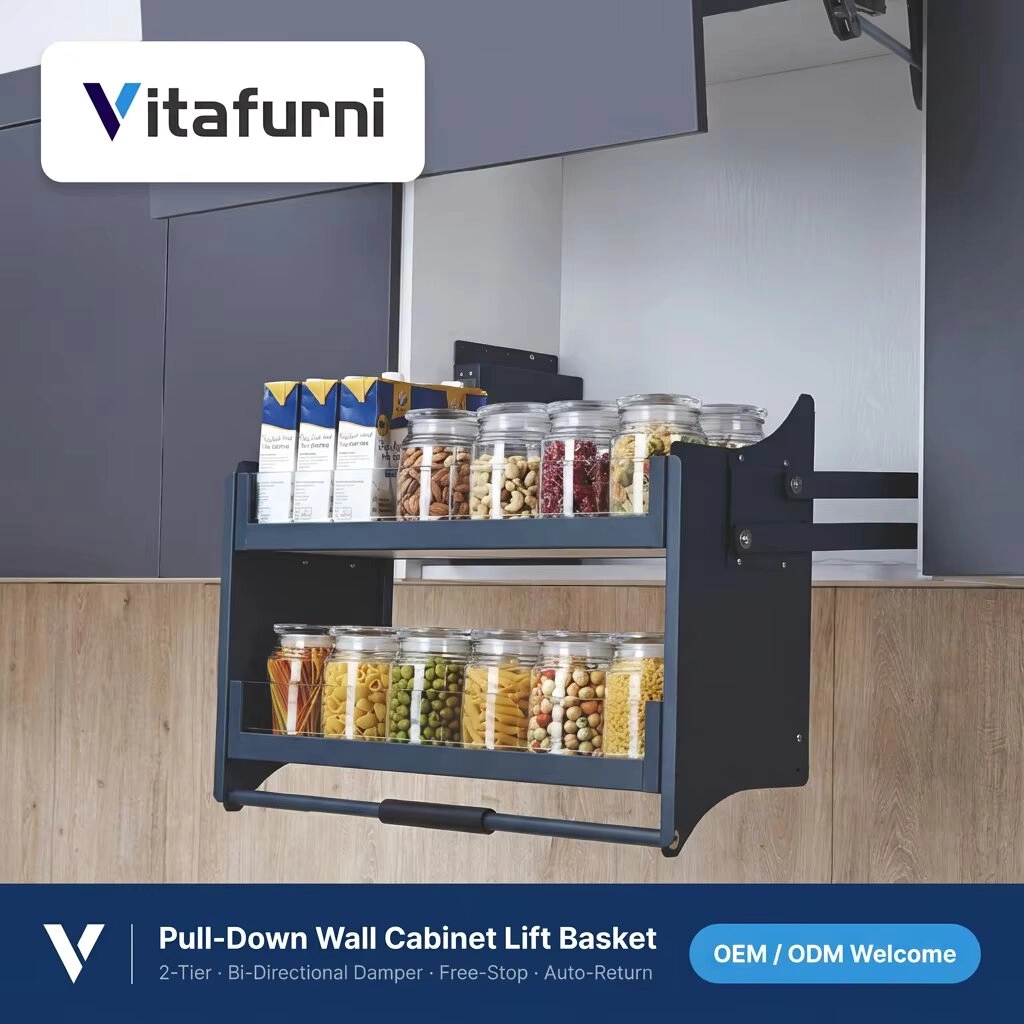
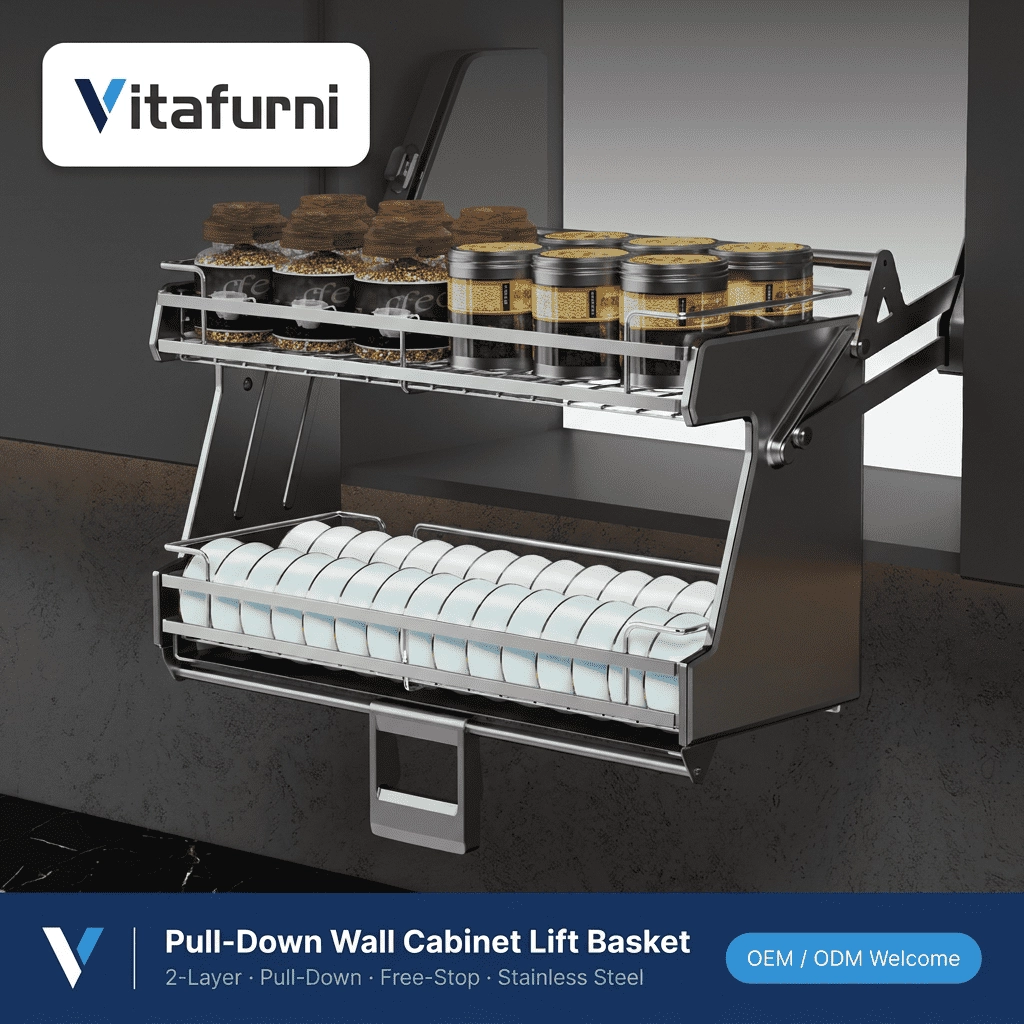
10. Recommended Vitafurni Pull-Down Shelf Options
The following products are included as practical matching examples for upper cabinet accessibility. We do not use them to make one universal promise about load, voltage, certification, or MOQ. Those details should be confirmed by model, project requirement, and order specification. The purpose here is to help buyers connect real use scenarios with suitable product directions.
11. Existing Kitchen Retrofit: Conditions to Confirm Before Ordering
Retrofit pull-down shelves for existing cabinets require more caution than new cabinet production. The cabinet may not have been designed for moving hardware. There may be fixed shelves, thin panels, hidden pipes, old hinges, or limited door opening angles. Before confirming the product, buyers should ask for clear cabinet photos, inner measurements, and a simple sketch of the surrounding countertop area.
For manual systems, the installer should confirm whether the side panels can hold the mechanism securely. For electric systems, the installer should confirm power availability, wiring route, and whether the user can reach the control. In both cases, the lowered path must be checked against existing countertop items. A retrofit project succeeds when the product fits the cabinet and the user can operate it without changing the daily kitchen routine too much.
Retrofit Confirmation Checklist
- Clear inner cabinet width, depth, and height.
- Door opening angle, hinge position, and handle clearance.
- Side panel material, thickness, and fixing strength.
- Fixed shelf, lighting, back panel, or face frame obstruction.
- Countertop appliances, sink faucet, cooktop, or range hood interference.
- User reach position after the shelf is fully lowered.
- Manual pulling effort or electric control position.
- Stored item type and realistic daily load.
12. OEM Planning for Cabinet Brands and Distributors
For cabinet brands and distributors, accessible upper cabinet storage should be organized into product versions rather than sold as one generic item. A practical line may include a mechanical pull-down basket for standard kitchens, a stainless steel version for premium mechanical hardware, and a motorized wall cabinet lift for smart or accessibility-focused kitchen collections.
The OEM process should define cabinet dimensions, target user group, product finish, handle style, control method, packaging, installation document, and sample testing method. If the product is intended for seated users or elderly users, the sample should be tested by movement sequence, not only by appearance. If the product is intended for retrofit distributors, installation instructions and tolerance notes become especially important.
| OEM Decision | What to Define | Why It Helps |
|---|---|---|
| Target User | Seated users, elderly users, premium homeowners, apartment kitchens, retrofit buyers. | Makes product selection based on real use, not only cabinet category. |
| Cabinet Standard | Width, depth, height, side panel thickness, door opening, installation holes. | Improves repeatability across cabinet collections and distributor orders. |
| Operation Method | Manual handle, free-stop damping, touch control, voice control, or other smart operation. | Connects the product with price level and user ability. |
| Sample Test | Real stored items, repeated operation, user reach, lowered height, movement stability. | Reduces the risk of approving a product that looks good but feels difficult to use. |
13. Practical FAQ for Accessible Pull-Down Shelf Selection
Q: Are pull-down shelves useful for wheelchair users?
A: They can be useful when the lowered shelf stops within the user’s reachable zone. The cabinet height, countertop depth, wheelchair approach space, handle or control position, and stored item weight should all be checked before selection.
Q: Should elderly users choose manual or electric pull-down shelves?
A: It depends on pulling comfort, storage load, and installation conditions. A smooth manual system may work well for moderate loads, while an electric system may reduce effort when power supply and cabinet clearance are suitable.
Q: What cabinet dimensions should be confirmed first?
A: Buyers should confirm clear inner width, depth, height, side panel strength, hinge position, door opening angle, and the final lowered path. Nominal cabinet width alone is not enough.
Q: Can pull-down shelves be installed in existing cabinets?
A: In many cases, yes, but the existing cabinet must be measured carefully. The installer should check internal clearance, side panel strength, door hinges, countertop obstruction, and whether wiring is needed for an electric system.
Q: What items are suitable for accessible upper cabinet storage?
A: Common items include cups, plates, bowls, dry food containers, spices, tea, coffee, and lightweight daily kitchen supplies. The final product should be selected according to real item size, load, and movement stability.
Q: How can Vitafurni help with accessible kitchen cabinet projects?
A: Vitafurni can review cabinet size, target user needs, stored item type, manual or electric operation preference, finish requirements, and purchase quantity to help match a suitable pull-down upper cabinet storage solution.
Final Buying Advice
A pull-down shelf is valuable because it turns difficult upper cabinet storage into reachable daily storage. The best system is not always the most complex one. For some projects, a smooth manual basket solves the access problem with simple installation. For other projects, a motorized lift creates better seated access, lower operating effort, and stronger smart kitchen positioning.
Before selecting a product, buyers should answer six questions: who will use the cabinet, what items will be stored, where the shelf stops after lowering, whether the handle or control can be reached, whether the movement path is clear, and whether the cabinet structure can support the system. These checks turn the product from a general accessory into a real accessible kitchen solution.
For new cabinet projects, share the drawings early so the shelf system can be planned into the structure. For existing kitchen retrofits, share photos, inner measurements, and a short description of the user’s access needs. Vitafurni can then help compare mechanical and motorized directions and recommend a more suitable upper cabinet storage solution.
Build Accessible Upper Cabinet Storage with Vitafurni
Send us your cabinet drawings, clear inner cabinet dimensions, stored item type, target user scenario, manual or electric operation preference, and estimated purchase quantity. Vitafurni will help match a suitable pull-down shelf system for your accessible kitchen cabinet project.
View Wall Cabinet Systems Discuss OEM Customization →

YouTube
Vitafurni Space Solutions
vitafurni